Tumor clonal evolution & oncogenomics
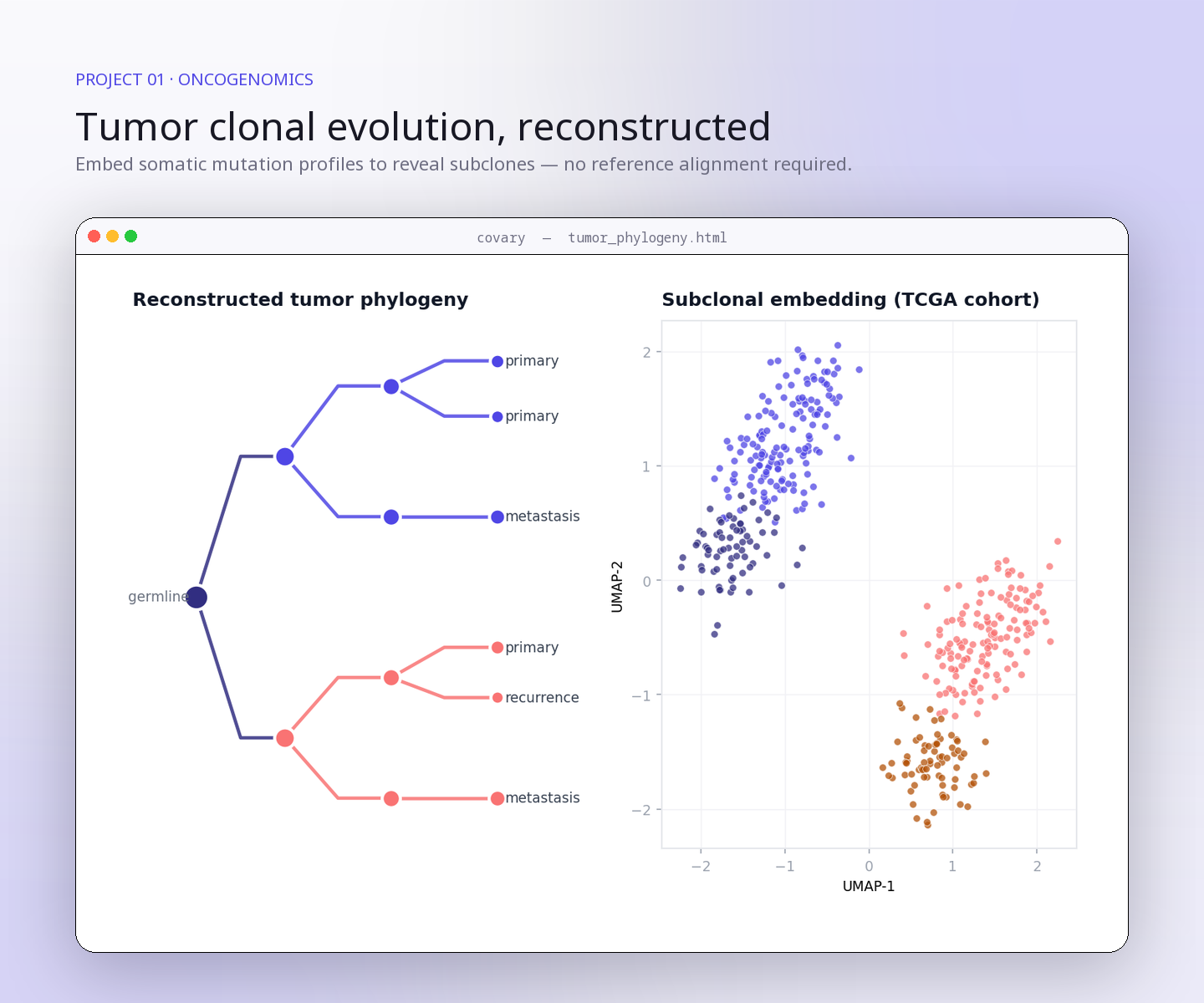
Cancer is an evolutionary process. Tumor cells accumulate somatic mutations over time, and different subclones compete and diverge — a process called clonal evolution. Understanding this subclonal architecture is critical for predicting treatment resistance and disease progression.
The problem: Existing phylogenetic tools were designed for germline sequences between organisms — not for intra-patient somatic mutation landscapes, which have different statistical properties, high noise, and no clear reference lineage.
How Covary helps
- Apply Mutagen-PX to generate patient-specific mutated FASTA profiles from TCGA cohort data
- Use Covary to embed and cluster these mutated sequences — revealing subclonal groupings
- Reconstruct tumor evolutionary trees without requiring aligned reference sequences
- Track divergence patterns across primary tumors, metastases, and recurrences
Viral outbreak & variant prediction
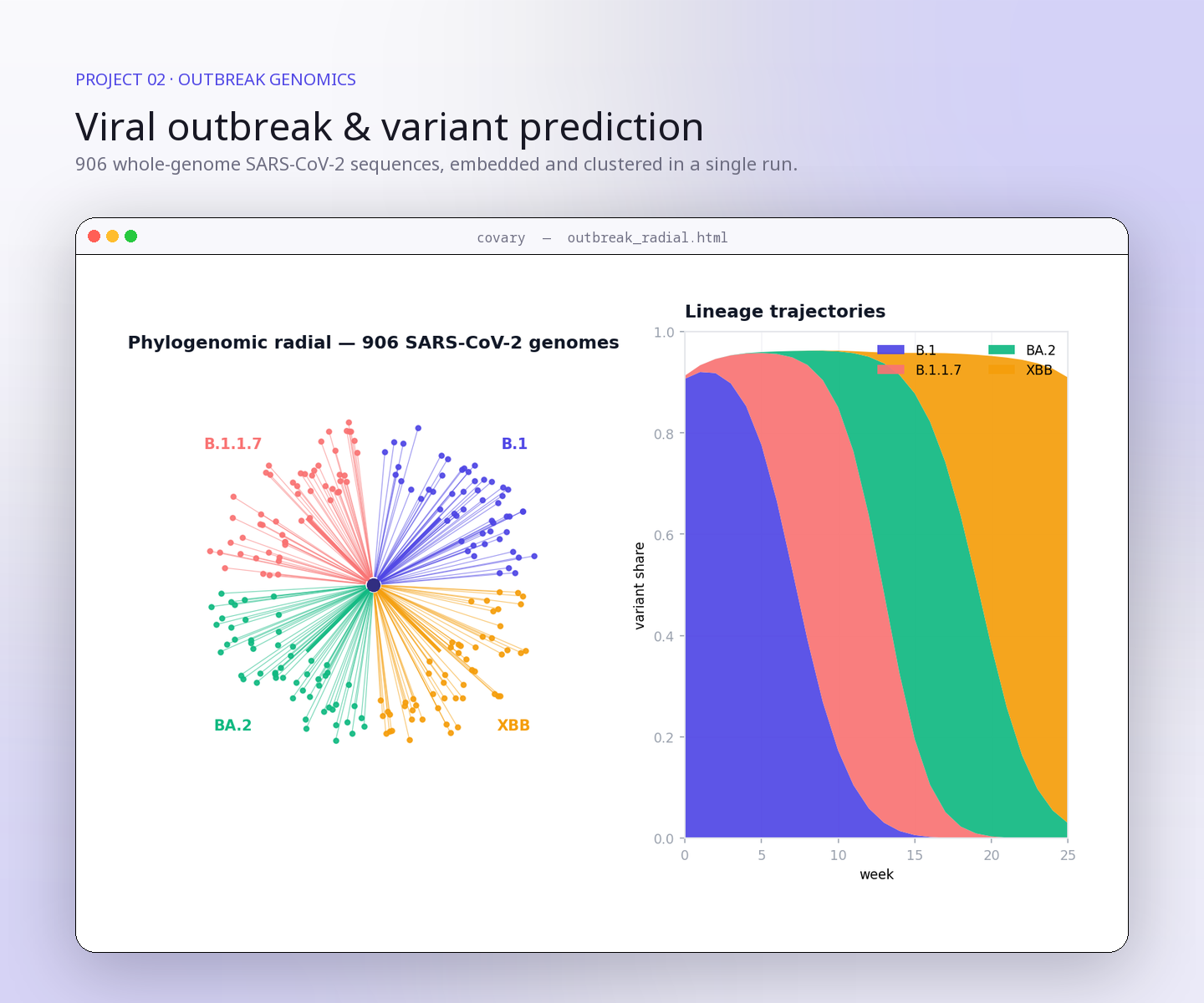
Viral pathogens evolve rapidly — especially RNA viruses like SARS-CoV-2, influenza, and dengue. During outbreaks, thousands of genomes are sequenced, requiring rapid phylogenomic analysis to identify transmission clusters, track variants, and predict which lineages may gain selective advantage.
The problem: Traditional tools cannot scale to thousands of genomes efficiently, and most require alignment as a prerequisite — a major bottleneck when speed matters.
How Covary helps
- Analyzed 906 whole-genome SARS-CoV-2 sequences in a single run in preliminary benchmarks
- Identifies transmission clusters and outbreak lineages without MSA
- Rapidly characterizes newly emerging variants and places them in evolutionary context
- Supports predictive modeling of variant trajectories using embedding distance patterns
Forensic & environmental genetics
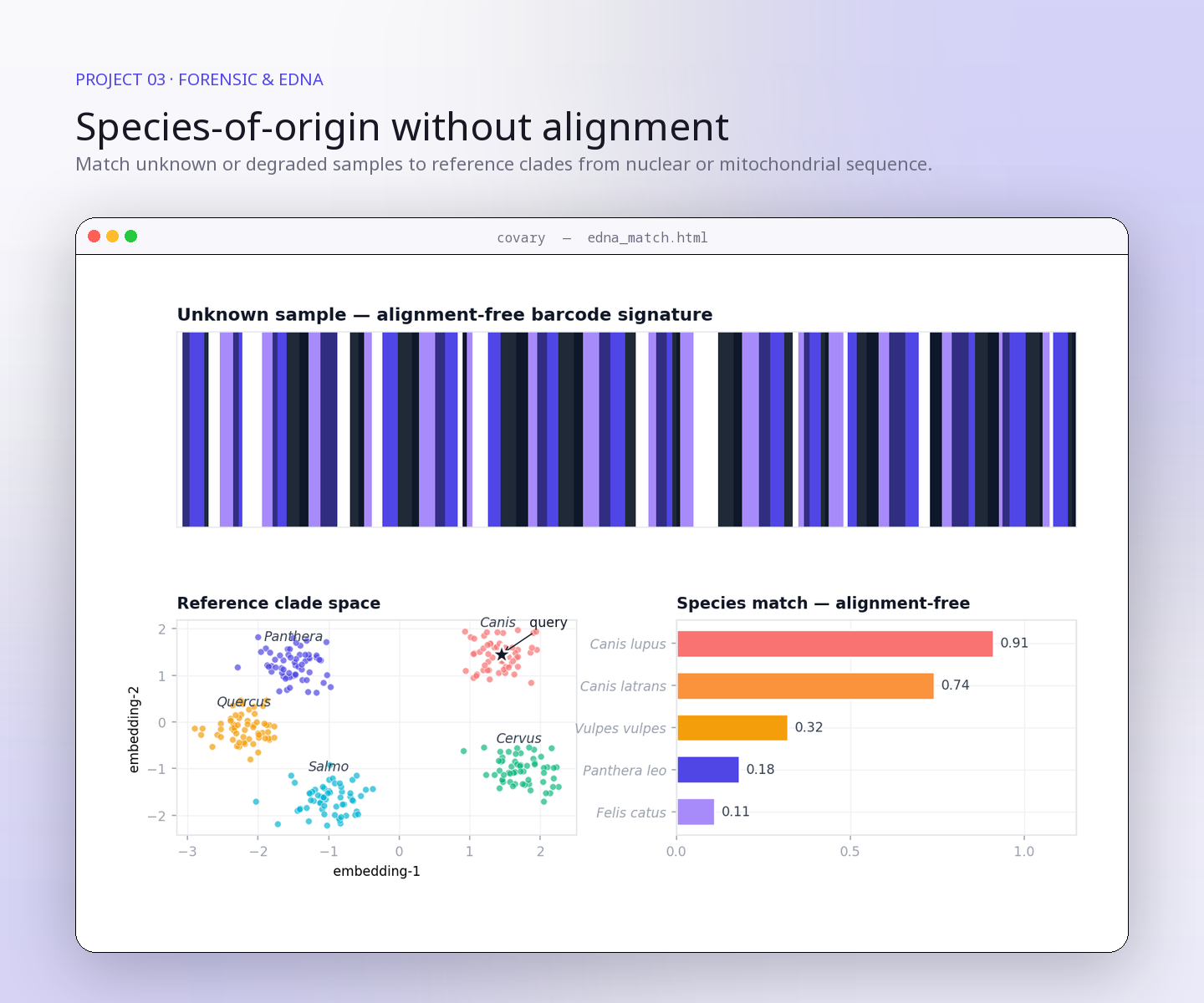
Forensic genetic analysis — whether for human identification, wildlife crime investigation, or environmental surveillance — often deals with degraded, mixed, or unknown DNA samples. The challenge is identifying the biological origin of a sequence with no assumed reference alignment.
The problem: Existing forensic tools often rely on a curated reference database and sequence alignment — which limits them to known species and well-preserved samples. Environmental metagenomic samples and cross-species detection are poorly served.
How Covary helps
- Use Covary's identification workflow to match unknown sequences to reference clades without alignment
- Apply to wildlife DNA barcoding — species determination from environmental DNA (eDNA)
- Integrate with forensic FASTA databases for rapid, alignment-free species-of-origin determination
- Works on both nuclear and mitochondrial sequences
Precision medicine & treatment response
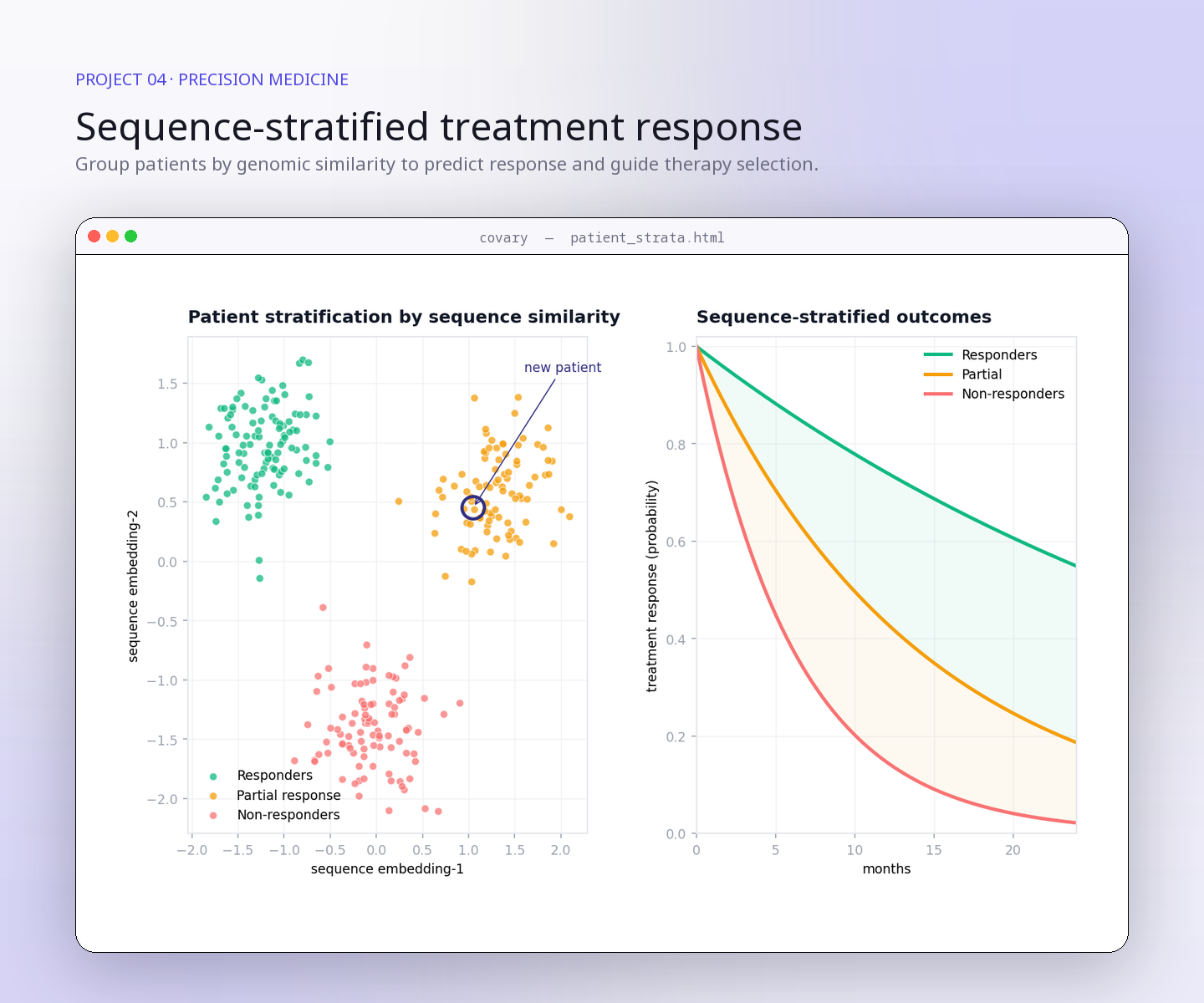
Treatment response in infectious disease and cancer is shaped by the genomic characteristics of the causative agent or tumor. Patients infected with divergent strains of the same pathogen may respond differently to the same drug — and this is largely driven by sequence-level differences.
The problem: Personalizing treatment requires sequence-level stratification of patients or pathogens at a scale and speed that traditional alignment-based tools cannot provide.
How Covary helps
- Embed patient-derived viral or tumor sequences and cluster by genomic similarity
- Identify sequence-based patient subgroups that may predict treatment response
- Integrate with existing clinical metadata to build sequence-to-outcome models
- Enable rapid reclassification as new sequences or resistance mutations emerge
Interested in collaborating on one of these projects?
Covary's beyond-phylogenetics work is open for research collaboration. Reach out to discuss licensing, data partnerships, or co-development of new protocols.